Why Are Manufacturers Turning to Swiss CNC for Small, Complex Parts?

Anthony Rill
Lead AI Researcher
Small parts can cause some surprisingly big headaches in manufacturing. A component may look simple on a drawing, but once you add tight tolerances, tiny holes, threads, grooves, or odd geometries, things get complicated fast. That’s one reason more manufacturers are looking closely at a Swiss machining center for this kind of work. Instead of forcing a conventional machine to handle a difficult little component, Swiss-style turning is built around the needs of small, detailed parts. And honestly, that difference matters when consistency and production speed both count.
What Makes Small Parts So Difficult to Machine?
Size is not the only problem. In many cases, it’s the combination of size and detail that makes a component difficult. A tiny medical fitting, electronic connector, automotive pin, or precision shaft might require several operations before it’s actually finished. Holding a small workpiece securely can also be tricky. If the part moves, vibrates, or flexes while being cut, even a very small amount of movement can affect the final dimensions. Then there’s tool access. Getting a cutting tool into a tight area without damaging another feature takes some careful planning. This is where ordinary turning methods can start feeling like they’re fighting the job instead of helping it.
How Swiss CNC Supports Better Part Control
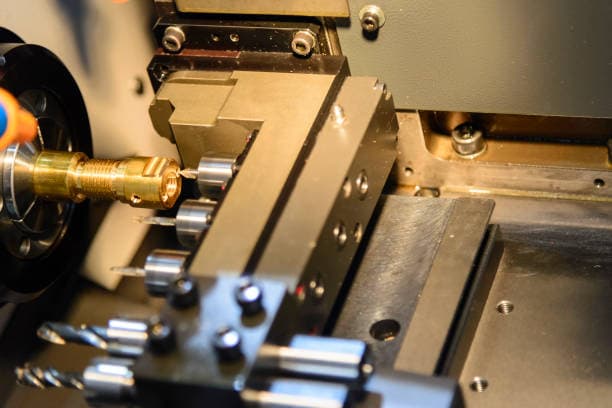
The big difference with Swiss-style machining is how the material is supported while it is being cut. In a typical Swiss setup, the stock passes through a guide bushing, with the cutting tool working close to that support point. That setup reduces the amount of material exposed during machining. Sounds like a small detail, but it can make a real difference with long, thin, or delicate components. Less unsupported material usually means less deflection and vibration. For a manufacturer chasing tight tolerances, that’s valuable. The machine isn’t just removing metal; it’s helping keep the workpiece stable while that removal happens.
Why Swiss Machining Handles Complex Features Well
Complexity is another big reason manufacturers are making the switch. A Swiss CNC machine can often perform multiple cutting operations during one setup. Turning, drilling, threading, grooving, and other operations can be combined depending on the machine and tooling arrangement. That means the part may not need to travel between several machines just to become a finished component. Every extra setup creates another opportunity for error. Someone has to reposition the part, establish another reference, and check the dimensions again. When the tolerances are extremely tight, those little changes can add up. Keeping more of the work in one setup can simplify the whole process.
Swiss Machining Is Built for Precision Production
There’s a reason Swiss machining is closely associated with precision manufacturing. The process is particularly useful when manufacturers need repeatable results across a large quantity of small components. Once the machine is properly programmed, tooled, and inspected, it can keep producing parts within the required specifications without relying on constant manual intervention. Of course, programming and setup still matter. A poorly planned job doesn’t magically become good because it is running on a Swiss machine. But when the process is dialed in, manufacturers can achieve a level of consistency that would be much harder to maintain with more manual or fragmented production methods.
Less Handling Can Mean Fewer Production Problems
Here’s something that doesn’t always get enough attention: handling. Moving a small part from one machine to another sounds harmless until you’re dealing with hundreds or thousands of pieces. Parts can get mixed up, scratched, incorrectly oriented, or simply measured differently from one workstation to the next. Consolidating operations helps cut down on some of those headaches. It can also reduce work-in-progress inventory because fewer unfinished components are sitting around waiting for the next operation. For manufacturers, that means a cleaner production flow. Not perfect, obviously. Manufacturing never works that neatly. But fewer handoffs generally make life easier for the people actually running the floor.
Where Swiss CNC Fits Into Modern Manufacturing
Swiss CNC machining is used across industries where small precision components are not optional. Medical and dental products are obvious examples because many devices depend on compact parts with demanding dimensional requirements. Aerospace, automotive, electronics, telecommunications, and instrumentation manufacturers also use precision turned components. Think pins, connectors, miniature shafts, fittings, screws, bushings, and other parts that might disappear between your fingers but still have to work correctly every single time. The material can vary too, from common steels and aluminum to stainless steel, titanium, brass, and other machinable alloys. The exact process depends on the component, of course, but the underlying need stays similar: make small parts accurately and make them the same way again and again.
Is Swiss CNC Only About Speed?
Not really. Speed gets plenty of attention because automated Swiss equipment can be productive, but focusing only on cycle time misses the bigger picture. Manufacturers are also looking at setup reduction, material usage, part quality, tool management, and overall process reliability. A faster machine that creates more scrap isn’t actually saving much. The goal is to build a process where the machine can produce good parts efficiently without creating another pile of problems downstream. For high-volume work, even a small improvement in cycle time or scrap rate can have a noticeable effect. For lower-volume jobs, the ability to handle complicated features without multiple setups may be the bigger advantage. It depends on the part.
Choosing Swiss CNC for the Right Application
The short answer is, Swiss CNC makes sense when the part demands the kind of precision and control that standard machining may struggle to provide efficiently. But manufacturers shouldn’t choose the process just because “Swiss” sounds more advanced. Start with the drawing. Look at tolerances, material, part length, diameter, features, quantities, and required secondary operations. Then consider how many setups the job would need using other methods. Sometimes conventional CNC turning is perfectly capable and makes more economic sense. Other times, especially with tiny and complicated components, Swiss technology can simplify the entire production route. That decision should come from the part requirements, not from chasing whatever machine happens to be popular.
Conclusion: Why Manufacturers Keep Looking at Swiss CNC
Manufacturers are turning to Swiss CNC because small components are often harder to make than they look. Tight tolerances, delicate geometries, multiple features, and repeat production can put serious pressure on a machining process. Swiss machining addresses many of those challenges by supporting the workpiece close to the cutting area and allowing several operations to be handled efficiently in one setup. Truth is, there’s no magic machine that fixes bad planning. But for the right application, Swiss CNC can give manufacturers better control, repeatability, and a more practical way to produce those tiny parts that have to be exactly right.